
Price to Replace O2 Sensor: Why You Need a Diagnostic Tool Like VD70S
If you've ever balked at a mechanic's bill for O2 sensor replacement—typically ranging from $200 to $500—you're not alone. The cost stems from parts, labor, and the risk of "guess-and-check" mistakes. But a diagnostic tool like the VD70S isn't just helpful—it's essential for slashing costs, avoiding errors, and ensuring repairs work.

Breaking Down the Price to Replace an O2 Sensor
The price to replace an O2 sensor isn't a flat fee—it's made up of three key parts that quickly add up, even for a "simple" repair:
- Parts cost: O2 sensors range from $50 for budget aftermarket options to $300+ for OEM (original equipment manufacturer) parts. The exact price depends on your car's make and model (e.g., a sensor for a luxury vehicle may cost twice as much as one for a compact sedan).
- Labor fees: Mechanics typically charge $80–$150 per hour. Replacing an O2 sensor takes 1–3 hours, so labor alone can cost $80–$450. This often makes up 50–70% of the total bill.
- Hidden extra costs: If the repair is done without a diagnostic tool, you may face additional expenses—like $100+ for a second sensor if the first one was misdiagnosed, or $200+ for repeat visits to fix unresolved check engine lights.
For most drivers, this means a total cost of $200–$500 per O2 sensor replacement. Understanding these breakdowns highlights why cutting waste (on parts or labor) is critical—and why a diagnostic tool like the VD70S becomes a cost-saving solution.
Why a Diagnostic Tool Is Non-Negotiable for O2 Sensor Replacement
Skipping a diagnostic tool to "save upfront" often backfires with wasted parts, extra labor, or repeat repairs. Here's why you can't afford to skip it:
1. Avoid Wasting Money on the Wrong O2 Sensor
Most cars have 2–4 O2 sensors (e.g., "bank 1 sensor 1" or "bank 2 sensor 2"). Without a diagnostic tool, you're guessing which fails. A 2025 AutoZone survey found 30% of customers return O2 sensors due to wrong purchases, wasting an average of $90 per mistake.
The VD70S eliminates this by pulling precise trouble codes from your car's ECU (e.g., "P0135: O2 Sensor Heater Circuit Malfunction, Bank 1 Sensor 1"), so you only buy the right part.
For an extra layer of certainty—like verifying if the sensor's voltage is truly outside the normal range—our guide Normal O2 Sensor Readings breaks down exactly what healthy O2 sensor data looks like, helping you rule out false codes.
2. Skip Costly "Trial and Error" at the Mechanic
Mechanics charge $80–$150 per hour, and without a diagnostic tool, they'll waste hours testing sensors. A shop might spend 2+ hours "trial-and-error" billing you $160–$450 in labor before replacing a sensor.
Even if you use a mechanic, a tool like VD70S lets you show them the exact code, preventing padded bills from unnecessary testing.
3. Ensure the "Fix" Actually Fixes the Problem
Replacing an O2 sensor requires resetting the ECU (Engine Control Unit) and running "adaptive learning"—otherwise, the check engine light returns, forcing repeat repairs. Cheap scanners can't do this, but the VD70S can:
- Reset the ECU to clear old errors.
- Run "sensor relearn" to sync the new part with the engine.
- Verify the new sensor works via live data.
How VD70S Slashes the "Price to Replace O2 Sensor"
1. Precision Diagnosis = Fewer Wasted Parts
The VD70S pinpoints exactly which sensor fails. For example, if your car throws a "P0155: O2 Sensor Heater Circuit Malfunction, Bank 2 Sensor 1" code, you buy just that $85 sensor—no guessing, no wasted parts.
2. DIY-Friendly = No Mechanic Labor Fees
Labor makes up 50–70% of O2 sensor replacement costs. With VD70S, you can DIY:
- Read the trouble code to find the faulty sensor.
- Replace the sensor (using a $20 O2 sensor socket tool).
- Clear the code and verify with live data.
- This skips $80–$450 in mechanic labor fees.
3. Long-Term Reliability = No Repeat Repairs
Skipping ECU resets leads to repeat issues. The VD70S lets you reset the ECU and run relearn functions, preventing $200+ repeat repair bills.
VD70S: A Long-Term Investment That Pays for Itself
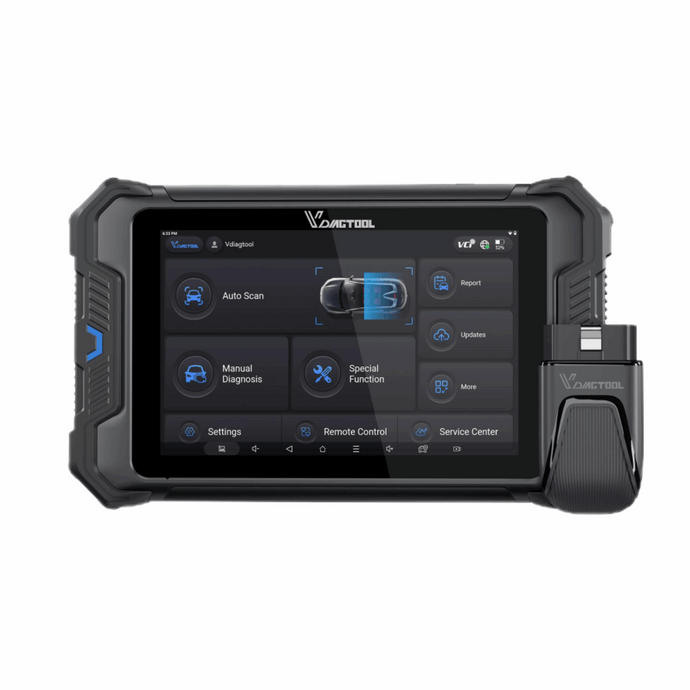
1. 39 Special Functions (Beyond O2 Sensors)
The VD70S isn't just for O2 sensors. It handles 39 special functions, like:
- TPMS reset (skip $50 shop fees).
- DPF regeneration (avoid $300+ diesel repair bills).
- Airbag/Oil light resets.
2. Beginner-Friendly Design
The VD70S has a 7-inch Android touchscreen (as easy as a tablet), 3 years of free updates (to stay compatible with new cars), and Type-C fast charging. It works with most cars (2000–2025+) via CAN FD/DOIP/FCA protocols.
3. Beats Cheap "Basic" Scanners
Cheap $30 scanners only read codes—they can't reset ECUs or run relearns. The VD70S delivers pro-level functionality at a mid-tier price, making it far more useful.
Ready to Stop Overpaying?
The VD70S eliminates wasted parts, skips labor fees, and prevents repeat repairs—all while being a long-term tool for every car issue. If you save $150 on one O2 sensor repair and $50 on a TPMS reset, you'll quickly cover its cost.


