
Bad Accelerator Pedal Position Sensor Symptoms
Your truck suddenly drops into Limp Mode. The dashboard flashes Reduced Engine Power. You press the accelerator, but the vehicle barely responds.
Naturally, most drivers assume the Accelerator Pedal Position Sensor (APPS) has failed.
But here's the real-world truth many repair articles miss: sometimes the sensor isn't the problem at all.
In modern Drive-by-Wire vehicles, the accelerator pedal, throttle body, battery, alternator, and ECU all depend on a stable electrical system. A weak battery, voltage drop, or damaged 5V reference circuit can easily trigger false APPS-related trouble codes like P2138, P2122, or P2135.
Before throwing expensive parts at the problem, here's how professional technicians actually diagnose APPS faults in the real world.

What Is an Accelerator Pedal Position Sensor (APPS)?
The Accelerator Pedal Position Sensor, often called the APPS sensor, is part of your vehicle's electronic throttle control system.
Older vehicles used a physical throttle cable connecting the gas pedal directly to the throttle plate. Modern vehicles use a Drive-by-Wire system, where the pedal sends voltage signals to the ECU instead.
Most APPS units contain:
- Dual or triple signal circuits
- 5V reference voltage from the ECU
- Ground circuit
- Redundant safety logic
This redundancy is critical. If Sensor 1 and Sensor 2 disagree, the ECU assumes there's a fault and may immediately trigger Limp Mode to prevent unintended acceleration.
In most vehicles:
- APP Sensor 1 increases from about 0.5V to 4.5V
- APP Sensor 2 changes at a different ratio for safety verification
The ECU constantly compares both signals thousands of times per second.
Top 4 Bad Accelerator Pedal Position Sensor Symptoms
1. Limp Mode or Reduced Engine Power
This is the most common complaint.
The vehicle may:
- Refuse to accelerate normally
- Limit speed to 30–40 mph
- Disable cruise control
- Feel extremely sluggish
This happens because the ECU no longer trusts the throttle input.

2. Dead Throttle Response
You press the gas pedal… and nothing happens.
In severe cases:
- RPM barely increases
- Acceleration cuts in and out
- The engine responds intermittently
This often points to a signal dropout inside the sensor or wiring harness.
3. Surging or Hesitation While Driving
A failing APPS may send unstable voltage signals.
The result:
- Random surging
- Hesitation during steady cruising
- Jerky acceleration
- Inconsistent throttle feel
Many drivers mistake this for a transmission issue.
4. Check Engine Light with APPS-Related Codes
Common OBD2 trouble codes include:
- P2121 – APP sensor range/performance
- P2122 – Low input voltage
- P2135 – Throttle/Pedal position correlation
- P2138 – APP Sensor 1 & 2 voltage disagreement
But here's the important part:
A stored APPS code does not automatically mean the pedal assembly itself is bad.

Quick APPS Diagnosis Chart
| Symptom | Most Likely Cause | What to Test First |
| Limp Mode | APP signal mismatch | Check APP1 & APP2 live data |
| P2138 after cold start | Weak battery voltage | Load-test battery |
| Random throttle dropouts | Broken harness wire | Perform the wiggle test |
| Hesitation only in winter | Connector corrosion | Inspect the pedal connector |
| APP codes after replacing the sensor | 5V reference issue | Check the shared 5V circuit |
How to Test an Accelerator Pedal Position Sensor
Step 1: Inspect the Connector and Harness
Start simple.
Look under the dash near the pedal assembly and inspect:
- Loose connectors
- Moisture intrusion
- Green corrosion
- Salt contamination
- Damaged wires
In snow-belt regions, winter road salt often corrodes the Weather-Pack terminals inside the connector.
Here's a real-world tip:
When checking the connector, don't jam your multimeter probes into the front of the plug. That can spread the terminals and create an intermittent connection later.
Professional techs use a method called back-probing, usually with a paperclip or dedicated probe pin inserted from the rear of the connector.
Step 2: Check the 5V Reference and Signal Voltage
With the key on and engine off (KOEO), test:
- 5V reference circuit
- Ground circuit
- APP Sensor 1 signal
- APP Sensor 2 signal
Typical values:
| Circuit | Normal Reading |
| 5V Reference | 4.8V – 5.1V |
| APP Sensor 1 | ~0.5V idle → 4.5V WOT |
| APP Sensor 2 | ~0.25V idle → 2.25V WOT |
| Battery Voltage | ~12.6V engine off |
The voltage should increase smoothly as the pedal is pressed.
Any sudden dropouts, spikes, or dead spots indicate a problem.
Step 3: Use Live Data on a Scan Tool
This is where professional diagnostics separate themselves from guesswork.
A quality scan tool with graphing live data can display:
- APP Sensor 1 waveform
- APP Sensor 2 waveform
- Correlation between the two signals
A healthy signal should look smooth and linear.
A failing sensor may show:
- Voltage spikes
- Sudden dropouts
- Flat spots
- Intermittent glitches

And here's something DIYers often miss:
A sensor can pass a static voltage test in the driveway but fail under vibration while driving.
That's why technicians perform a wiggle test.
While monitoring live data:
- Gently move the harness
- Tap the pedal assembly
- Flex the connector
If the graph suddenly glitches, you've likely found the fault.
Why Replacing the APPS Often Doesn't Fix the Problem
This is the part most articles never explain.
Many vehicles share the same ECU 5V reference circuit between multiple sensors:
- APP sensor
- Throttle body
- MAP sensor
- AC pressure sensor
- EGR position sensor
If one sensor internally shorts, it can pull the entire 5V circuit low.
The ECU then sees incorrect APP readings and sets:
- P2138
- P2122
- P2135
Even though the pedal sensor itself is perfectly fine.
We've seen cases where replacing the APPS, throttle body, and even the ECU solved nothing — because the actual problem was a shorted AC pressure sensor dragging the 5V network down.
That's why checking the entire reference voltage circuit matters.
Can a Weak Battery Cause False APPS Codes?
Absolutely.
Modern engine control systems are extremely voltage-sensitive.
The ECU relies on a stable system voltage to generate a precise 5V reference signal. If the battery voltage drops too low:
- Sensor readings become unstable
- APP correlation errors appear
- Limp Mode activates
A weak battery may still crank the engine but fail under load.
During cold starts, voltage can briefly collapse below 10.5V, causing the ECU to misinterpret sensor signals.
This is especially common during winter.
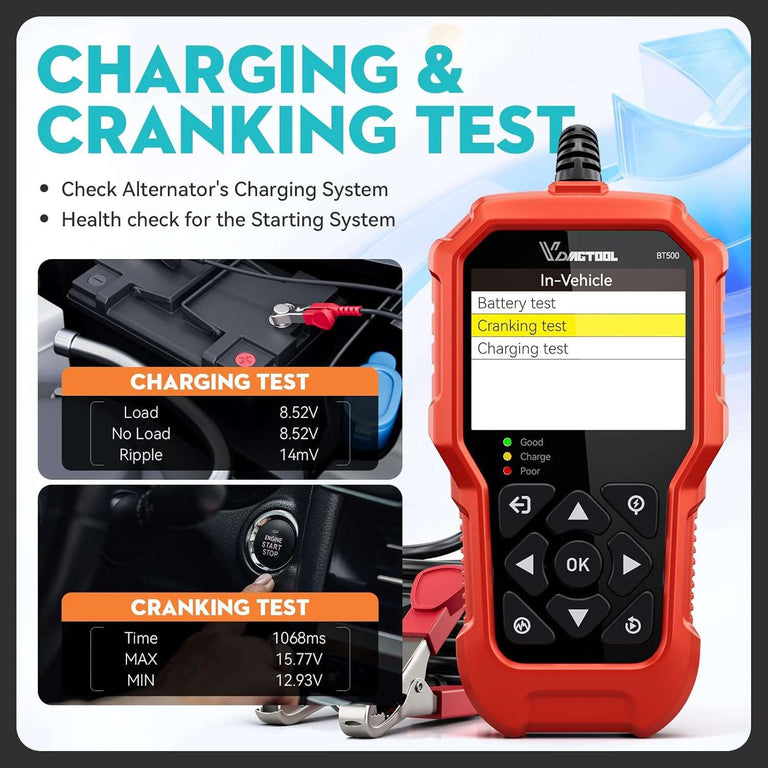
Before replacing a $200 pedal assembly, always:
- Load-test the battery
- Check charging voltage
- Inspect the alternator ripple
In many cases, fixing the battery problem with a car battery tester eliminates the APPS code.
APPS vs. Throttle Body: Which One Is Actually Bad?
| Diagnostic Feature | APPS Failure | Throttle Body Failure |
| Main Symptom | No throttle response | Rough idle or sticking |
| Engine Idle | Usually normal | Often unstable |
| Pedal Data | Erratic APP voltage | APP data is usually normal |
| Physical Clue | Limp Mode immediately | Carbon buildup in the throttle body |
| Quick Test | Monitor pedal percentage | Inspect the throttle plate |
These faults are commonly confused because both can trigger similar throttle-related codes.
Real-World Case Study
Vehicle:
2014 Chevy Silverado
Complaint:
- Reduced Engine Power
- P2138 code
- Random throttle loss during cold mornings
What Happened:
The owner replaced:
- Accelerator pedal assembly
- Throttle body
The problem kept returning.
Root Cause:
Battery voltage dropped to 9.8V during cold cranking.
The unstable voltage caused false APP correlation errors.
Fix:
Replacing the weak AGM battery solved the issue completely.
No additional parts were needed.
Final Thoughts
A bad accelerator pedal position sensor can absolutely cause:
- Limp Mode
- Hesitation
- Dead throttle response
- Check Engine Light codes
But modern throttle systems are heavily dependent on stable voltage and clean sensor communication.
That means:
- A weak battery
- Corroded connector
- Damaged wiring
- Faulty 5V reference circuit
can all mimic a failed APPS.
The smartest diagnosis strategy is not replacing parts blindly — it's verifying the electrical system first.
Because in today's vehicles, the real problem is often hidden far beyond the gas pedal itself.


